A suburb of flats
Neutral Bay and Cremorne carry one of the highest concentrations of apartments on the North Shore. Roughly, the stock falls into three groups:
Interwar flat buildings from the 1920s and 1930s — two and three storeys, face brick, often Art Deco or Spanish Mission detailing, clustered around Kurraba Road, Cremorne Point and the streets below Military Road. Many retain original floor plans with a small, enclosed kitchen off a hallway.
1960s–1980s walk-ups and mid-rise blocks — the largest group. Concrete slabs, galley kitchens and bathrooms stacked floor on floor, plumbing and wiring that may be original, and no lift in many cases.
Newer apartments along the Military Road corridor and harbourside buildings on Cremorne Point and Kurraba Point, with lifts, loading docks, building managers and detailed renovation by-laws.
Period houses and semi-detached cottages also sit in pockets through Neutral Bay and Cremorne, many within conservation areas.
The strata timetable
For most kitchens here, the order of events is set by the building:
- Read the by-laws — renovation rules, hours, insurance and lift conditions.
- Speak to the strata manager about what approval the scope needs.
- Provide notice and details — drawings, the contractor's licence and insurance, a program.
- Approval by general resolution for a typical kitchen; a special resolution and by-law where common property is affected.
- Book lifts, loading and parking for demolition and delivery days.
Starting this before the design is finished is sensible, because meeting dates rarely line up with a joinery manufacturing slot.
Interwar flats: working with thick walls
Interwar flat kitchens tend to be small but well built. Solid brick internal walls are common, and removing them to open the kitchen to the living room may affect structure and common property.
Where the wall stays, the kitchen is designed as a well-organised room: full-height joinery, a compact butler's-style tall pantry, a window bench and good lighting. Painted joinery and simple panel profiles tend to suit the period better than slick gloss.
1960s–80s units: fixing what is behind
In a 1970s galley kitchen the real work is often behind the cabinets:
- Old galvanised or copper plumbing at the end of its life
- Wiring and circuits that cannot carry modern appliances
- Asbestos-containing materials in splashback sheeting or vinyl floors, tested before demolition
- Uneven slab surfaces under decades of flooring
A new kitchen that ignores these problems will not last as long as its finishes.
Harbour apartments: light and glare
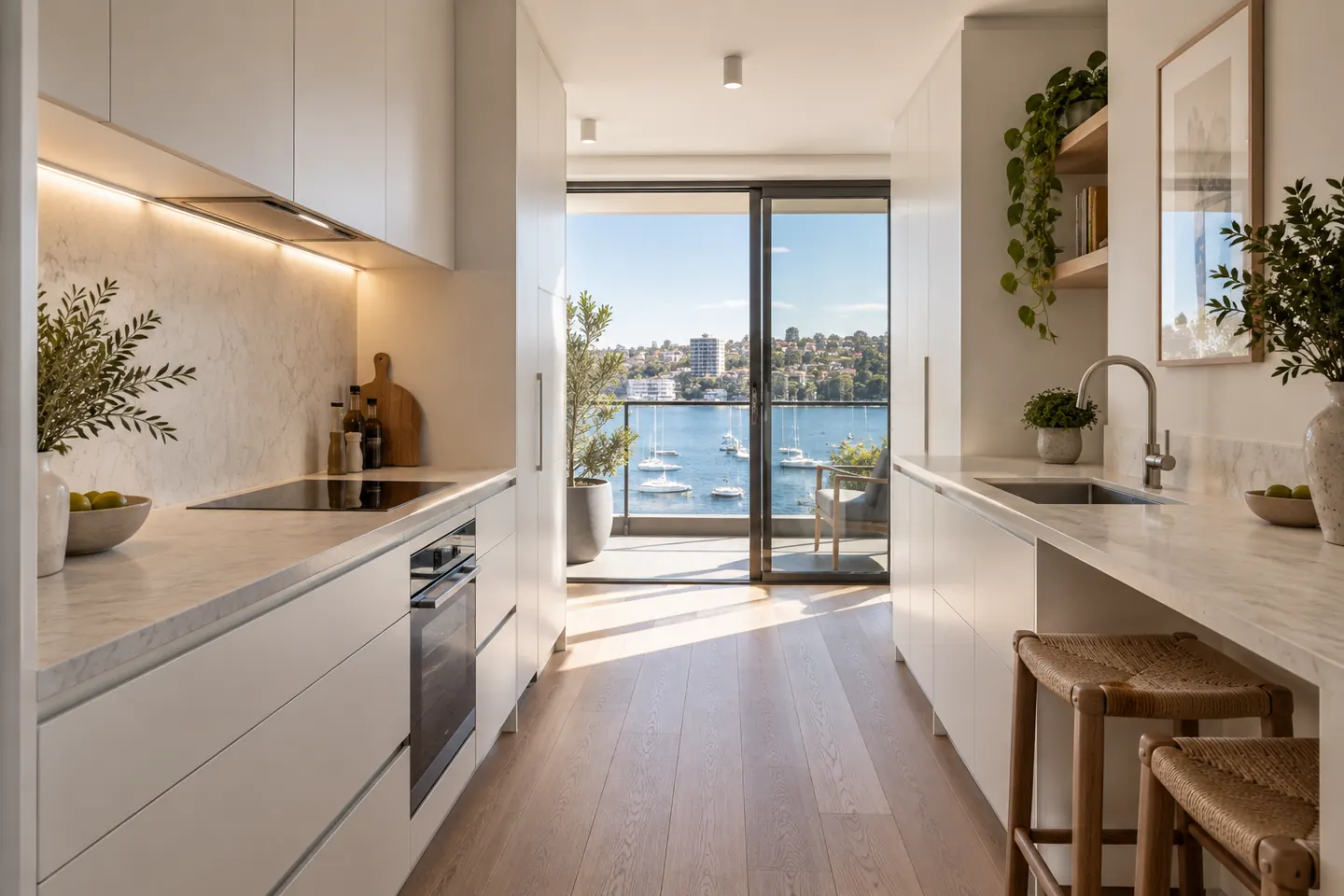
Apartments on Cremorne Point and Kurraba Point often have large glazing facing the harbour. That light is the reason people buy, and it is hard on materials:
- UV-stable surfaces such as porcelain and quality laminates hold colour better than some veneers
- Matt finishes reduce glare on benchtops and door faces
- Task lighting still matters at night, when the view becomes black glass
See benchtops and splashbacks.
Deliveries on a ridge
Military Road is busy and side streets are narrow and permit-parked. Stone slabs, joinery and waste all need a delivery window, a lift or stair path, and protection for common areas. Long benchtops are checked against lift dimensions before cutting.
Houses too
Neutral Bay and Cremorne houses — Federation cottages, semis and interwar bungalows — follow the approach described on the Mosman page: internal work is usually straightforward, while external changes in a conservation area need checking with North Sydney Council, or Mosman Council on the eastern side of Cremorne.
Nearby
Also serving Kurraba Point, Cremorne Point and Cammeray. See apartment and strata kitchens for the detailed approval guide, and the 2026 cost bands.
Call 02 5657 4821 or send your kitchen details through.
Questions people ask before they commit
Which council covers Neutral Bay and Cremorne?
Neutral Bay, Kurraba Point and most of Cremorne, including Cremorne Point, are in North Sydney Council. A section of Cremorne on its eastern side falls within Mosman Council. For apartment kitchens the owners corporation is usually the more important approval; for houses and any external work, the correct council's controls apply.
How long does strata approval take for a kitchen renovation?
It depends on when the owners corporation or strata committee next meets and what your by-laws require. A kitchen renovation is typically a minor renovation needing a general resolution, which can take several weeks to schedule. Work affecting common property, such as structure or waterproofing, generally takes longer because a special resolution and by-law may be needed.
Can I have induction in an older Neutral Bay flat?
Often, but the unit's electrical supply and the building's main switchboard need checking first. Some older buildings have limited capacity per unit. Any upgrade to supply or wiring that touches common property may require owners corporation approval.
Are there heritage controls in Neutral Bay and Cremorne?
Yes. North Sydney Council has heritage conservation areas and listed items across the lower North Shore, including around Neutral Bay, Kurraba Point and Cremorne. Internal kitchen work is rarely affected, but external changes to buildings in these areas can be.