Where things stand since July 2024
For roughly two decades engineered stone was the default kitchen benchtop in Sydney. From 1 July 2024 its manufacture, supply and installation was banned nationally because of the silicosis risk to the workers who cut it.
That changed the conversation. Existing engineered stone tops can stay in place, but a new North Shore kitchen now chooses from a wider, more varied set of materials — each with its own feel, maintenance and cost profile.
The materials, honestly compared
| Material | Heat | Stains | Scratches and chips | Repair | Character |
|---|---|---|---|---|---|
| Granite and quartzite | Very good | Good once sealed | Very hard; edges can chip | Chips can be filled | Natural variation, cool to touch |
| Marble | Good | Etches with acids | Softer; scratches and etches | Can be re-honed | Ages visibly, develops patina |
| Porcelain | Excellent | Excellent | Hard surface; edges can chip | Chips are difficult to hide | Large slabs, consistent pattern |
| Solid surface | Poor with hot pans | Good | Scratches, but sands out | Seams and marks repairable | Warm, seamless, integrated sinks |
| Stainless steel | Very good | Excellent | Scratches quickly, then evens out | Can be refinished | Professional, hygienic |
| Timber | Poor with hot pans | Needs oiling | Dents and marks | Sands and re-oils | Warm, softens a period room |
| High-pressure laminate | Poor with hot pans | Good | Moderate | Replaced rather than repaired | Economical, many patterns |
Numbers on a spec sheet are only a starting point. A household that cooks with high heat every night has a different priority list from one that mainly makes coffee and entertains.
Natural stone on the North Shore
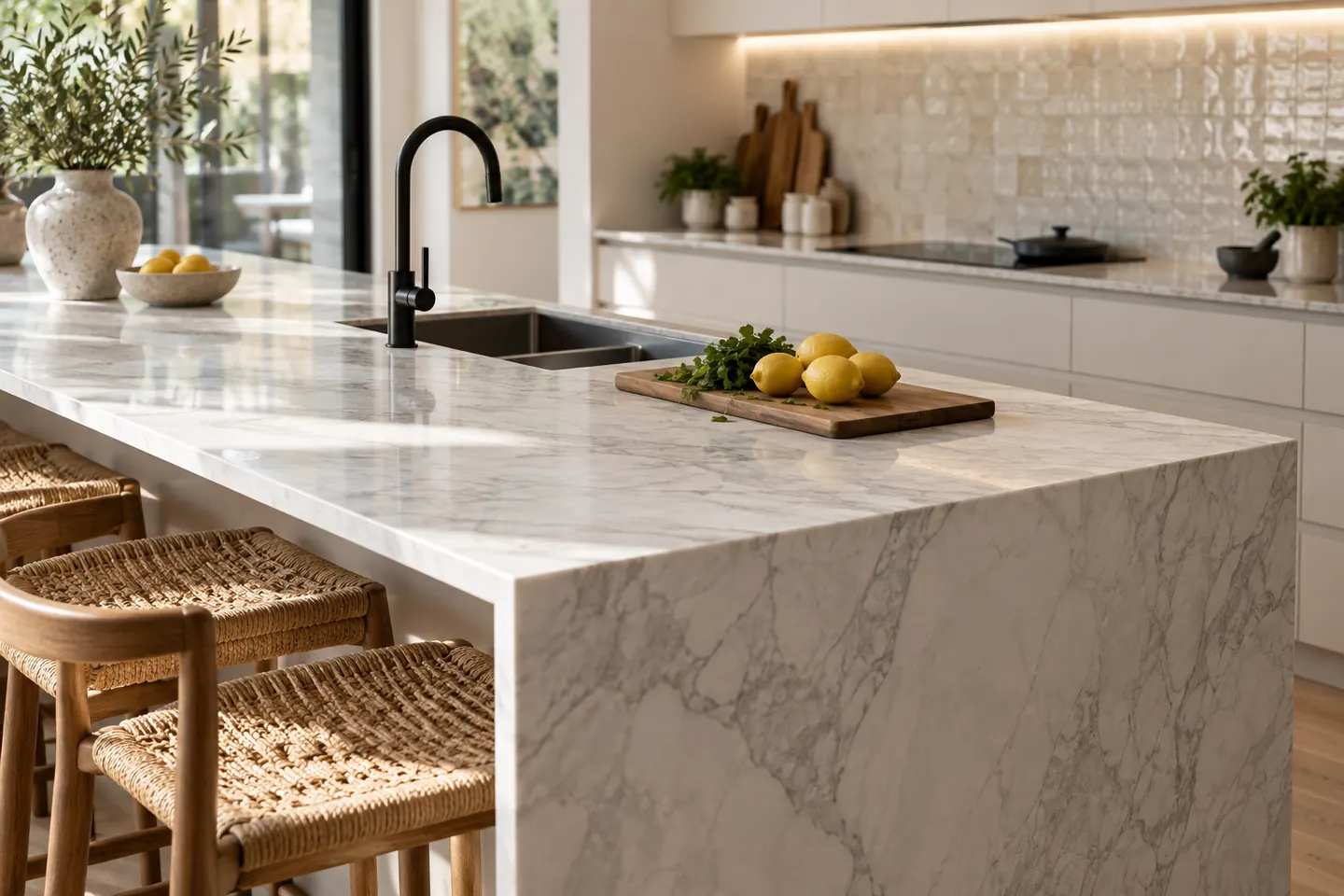
Marble, granite and quartzite suit the architectural character of many Mosman, Lindfield and Cremorne homes. They are also the most variable materials in this list: two slabs from the same quarry can look very different.
- Choose the slab, not the sample. Where possible, slabs are viewed and the layout of veins across joins is agreed before cutting.
- Honed or polished. Honed hides etching and fine scratches; polished intensifies colour and shows every mark.
- Sealing is part of ownership, not a one-off.
- Weight. Heavy slabs on long islands need cabinets built to carry them and access to get them into the house — a real consideration on steep harbourside sites with long stairs.
Porcelain and sintered surfaces
Porcelain slabs can be very thin and very large, which suits waterfall ends, full-height splashbacks and island tops with few joins. They are highly resistant to heat and fading, a useful property in bright, north-facing kitchens and harbour-view apartments with big glazing.
The catch is fabrication. Porcelain rewards experienced cutting and careful edge detailing; a mitred edge done well looks like solid stone, done badly it chips.
Timber, steel and solid surface
Timber softens a period kitchen and pairs well with painted joinery. It needs oiling and will mark, which some people consider the point.
Stainless steel is what commercial kitchens use for good reason. It develops an even scratch patina and can integrate the sink seamlessly.
Solid surface allows integrated sinks and invisible joins, and scratches can be sanded out. It dislikes hot pans.
Mixing materials is common: stainless or timber on a working bench, stone or porcelain on the island people see.
Splashbacks
- Glass — seamless, reflective, easy to wipe. Colour-backed glass needs precise measuring around power outlets.
- Tiles — handmade, zellige-style, subway or large format. Grout lines need a good sealer near the cooktop.
- Matching slab — the benchtop material carried up the wall for a continuous look. Porcelain suits this well because of its weight and size.
- Stainless or mirror — practical, or light-amplifying in a dark galley.
Behind any cooktop, required clearances to combustible surfaces and rangehood heights come from the appliance instructions and the relevant standards, and are checked during design.
Details that change the price
Thickness, edge profile, waterfall ends, undermount sink cut-outs, drainage grooves, cooktop cut-outs and the number of joins all move the cost as much as the material itself. The quote names each one. See the 2026 cost bands.
Related: cabinetry and joinery and full kitchen renovations.
Call 02 5657 4821 or send your kitchen details through.
Scope
Related work
- 01Full Kitchen RenovationsThe whole room rebuilt — services, walls, joinery, stone and lighting — sequenced so the house is without a kitchen for weeks, not months.
- 02Kitchen Design & LayoutPlans drawn to the dimensions of the room you actually have: clearances, sightlines, daylight and where the appliances really fit.
- 03Custom Cabinetry & JoineryTwo-pack, timber veneer, laminate and board — joinery specified by substrate, edge and hardware, not by a catalogue photo.
- 05Butler's Pantries & SculleriesA working room behind the show kitchen — sink, bench, appliances and storage — where the floor plan has space to give.
- 06Apartment & Strata KitchensKitchens in harbourside and walk-up units, planned around by-laws, lift bookings, fixed risers and neighbours through the wall.
Questions people ask before they commit
When was engineered stone banned?
The manufacture, supply and installation of engineered stone benchtops, panels and slabs was prohibited across Australia from 1 July 2024, because cutting and polishing it exposed workers to respirable crystalline silica and a high risk of silicosis. Existing engineered stone benchtops can remain in place, but new ones cannot be installed.
Does marble stain?
Marble is a calcium-based stone, so acids such as lemon juice, wine and vinegar can etch the polished surface, and oils can stain if left. Sealing helps with staining but does not prevent etching. Honed finishes disguise etching better than polished ones. Many owners accept the patina; others prefer a harder natural stone or porcelain.
Is porcelain a good benchtop?
Porcelain is hard, highly resistant to heat, UV and staining, and available in large thin slabs with stone-like patterns. Its weaknesses are edge chipping from hard knocks and the fact that the pattern often sits on the surface, so mitred edges are used to disguise the core. Fabrication quality matters a great deal.
What is the best splashback material?
Glass is seamless and easy to clean; tiles offer texture and are simple to replace; a matching stone or porcelain slab gives a continuous architectural look; stainless steel suits heavy cooking. Behind a gas cooktop, clearances and heat resistance must be checked against the appliance requirements.